Why Investors Pass on Startups: 3 Reasons We Saw Live
4 investors, 6 startups, 2 yeses each. Here are the 3 reasons they said no at The Pitch Room, and how to fix each one before you pitch.

How The Pitch Room works
Every founder who pitches is vetted by the Moat team first. They pitch live, take questions from the judges, and then each judge votes yes or no. With two yeses each across six pitches, the judges can't back every startup they like. On the night, three of the six founders got at least one yes. Hintora and the betting platform got three each, and Lattice got one. The other three left without a yes. We run The Pitch Room every week. If you want investors' feedback on your pitch before you raise, get your moat score here:
The 3 reasons investors said no
Each one ends with something you can fix before your own pitch.
1. No proprietary data
Michael Bennett pitched Jeani, an injury-prevention health app. It had real users, and the story behind it was one of the strongest of the night. But the app ran on wearable data from other companies, which led to the question that came up again and again over the evening: "What stops someone from just doing the same thing?" Anyone with the budget could license the same data and build something similar, and there wasn't a strong answer to that. The pitch unfortunately got four no's.

Fix it before you pitch: name the data or advantage that only you will own after 12 months of growth. A competitor can license the same data you do. Data you collect yourself, and that improves the product with every use, is much harder to copy.
2. Not different enough
Hintora is an AI screen assistant, which is a crowded category. During the pitch, one judge compared it with tools he already uses. Hintora still came away with three yeses out of four, and went on to post the highest Moat Score of the night. So the comparison didn't sink it. One judge still passed, though, and it's a question you can prepare for.

Fix it before you pitch: have a one-line answer to "how is this different from X?" ready for the three tools an investor is most likely to name.
3. Market too small
InternAlly is a careers platform for students. The judges liked the product but couldn't see a venture-sized outcome. Angels and VCs expect most of their investments to fail, so they need the ones that work to become very large. A good product in a small market often gets a no for that reason alone, which is what happened here.

Fix it before you pitch: show how your first market leads to a bigger one, with numbers. Start with the customers you can win now, then show the next markets the same product can reach.
The founder who turned a no into 3 yeses
The best moment of the night came from an 18-year-old founder. Michael Xie pitched (Stealth), a betting platform with a crypto token built into the product. The judges pushed hard on the token and the risk it added.
He agreed to scrap it on the spot. Three of the four judges said yes. Plenty of founders would have defended it. Before you pitch, work out which part of your startup is the business and which part is extra, so you can drop the extra if an investor pushes on it.

The judges' guesses against the real Moat Scores
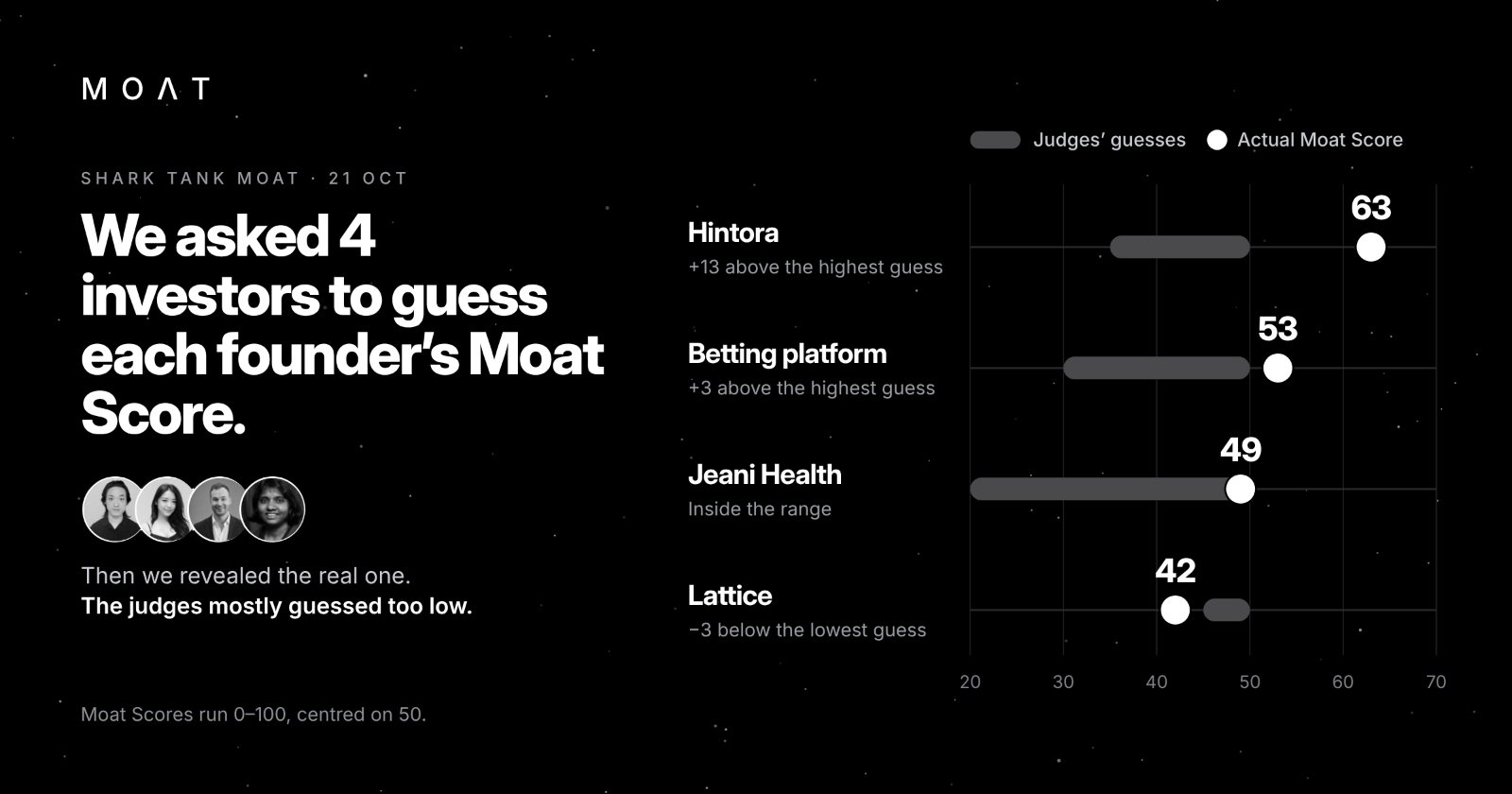
Before each reveal, our host Marco asked the judges to guess the founder's Moat Score out of 100. Two founders scored higher than every judge guessed. Hintora's 63, the top score of the night, beat guesses of 35 to 50, and the betting platform's 53 beat every guess of 30 to 50. An investor's first impression can undersell you or flatter you, so it helps to know your own score before you're in the room.
What angel investors look for, based on the night
Across the six pitches, these angels and VC wanted to see four things at pre-seed:
- A reason the startup is hard to copy, such as data you own or technology competitors can't easily match.
- A market big enough to produce a very large company.
- A team that covers both building the product and selling it.
- Proof the product exists and people use it, with honesty about what's still manual.
Before you pitch: a 6-question checklist
Run through these before your next investor meeting. If any answer takes you more than a sentence, that's where to work.
What stops someone from doing the same thing?
How are you different from the tools an investor already uses?
How big can this get?
What is the one product and the one customer you're proving first?
Who on the team sells and raises money?
What works today, and what is still done by hand?
Get your Moat Score and see how you'd answer before an investor asks.
Thanks to our judges, Aric Chang, Alyssa Tsai, Christopher Rohrer and Divya Singh, and to every founder who pitched.
Alex Montoro is the Co-Founder of Moat, a community of vetted founders, and co-hosts The Pitch Room, where founders pitch live to angel investors and VCs.
FAQ
Why do investors pass on startups?
Most passes come down to a few things: the startup is easy to copy, the market is too small, the team is missing a key skill, or the product isn't far enough along. On The Pitch Room on 21 October, every no fell into one of three reasons covering those areas.
What do angel investors look for at pre-seed?
A team that can build and sell, a market big enough to matter, early proof that people want the product, and a credible reason it will get harder to copy as it grows. Few pre-seed startups have all of these, so investors look for a clear plan for the gaps.
How do I answer "what's your moat?"
Name the advantage you'll own in 12 months that a competitor couldn't buy or build quickly, such as proprietary data, network effects or hard technology, and give the number you track to show it's growing. If you don't have one yet, say plainly what you're building towards.
What is a Moat Score?
A score from 1 to 100 for how defensible your startup is, based on quick questions about the founder, market, product and moat. It takes about two minutes!
Latest from the blog
-
LinkedIn Strategy for Founders: 7 Rules From a Ghostwriter
The LinkedIn strategy a 200+ client ghostwriter gave Moat founders: what to post, who to connect with, what to measure, and when to ask for the sale.
-
What is a startup moat? How to measure and build yours
A startup moat is what makes your business hard to copy. Learn the main types, what investors look for, and score your own moat in 3 minutes.